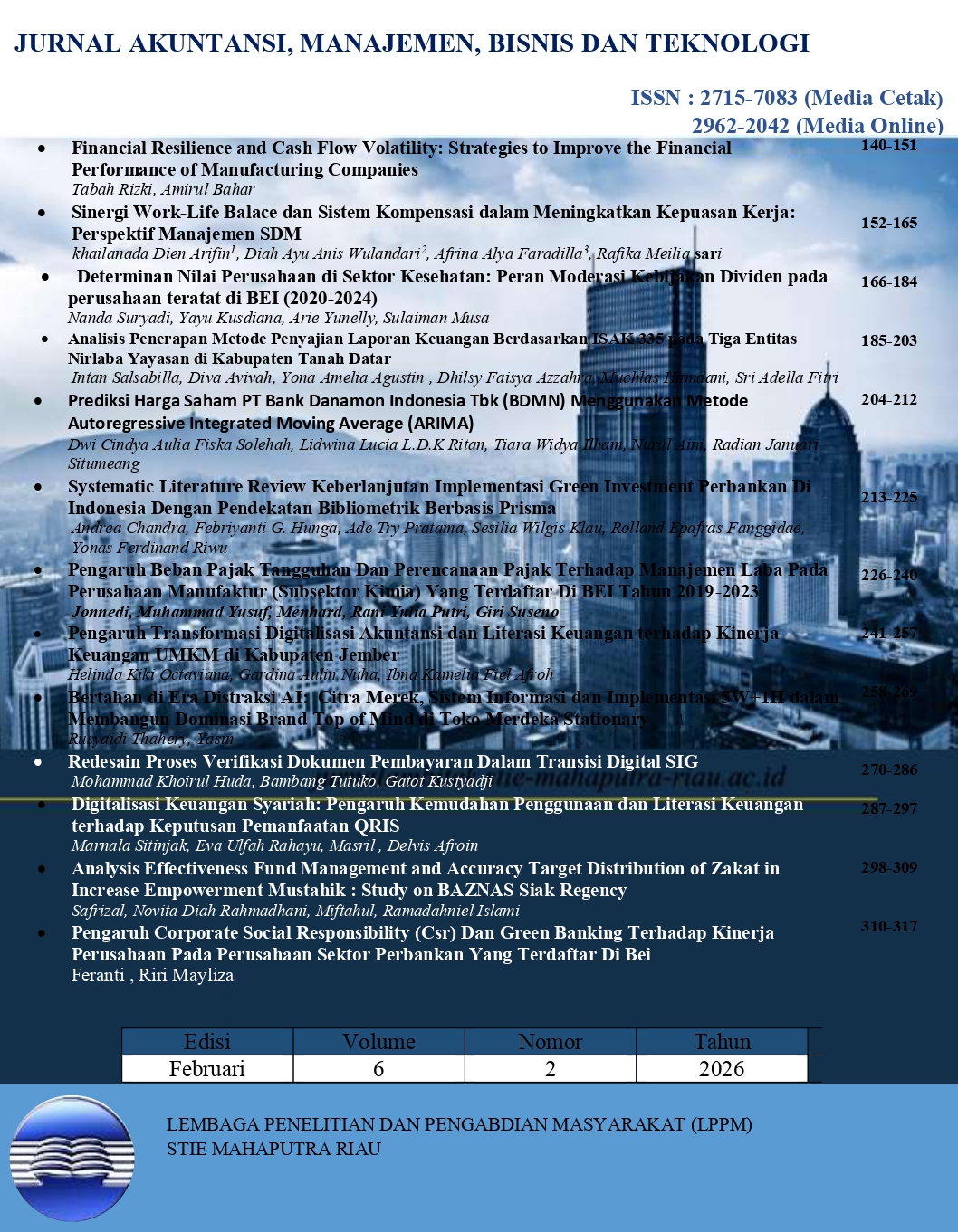
Analisis Penerapan Metode Penyajian Laporan Keuangan Berdasarkan ISAK 335 pada Tiga Entitas Nirlaba Yayasan di Kabupaten Tanah Datar
DOI:
https://doi.org/10.56870/rv0adm29Kata Kunci:
ISAK 335, Financial Statements, Non-Profit EntityAbstrak
As a primary instrument for non-profit organizations, financial statements play an important role in realizing transparency towards stakeholders. ISAK 335 is the latest regulation replacing ISAK 35 and PSAK 45, serving as a guideline for the presentation of financial statements of non-profit entities in Indonesia. This study aims to examine the conformity of financial recording practices applied by three non-profit entities in Tanah Datar Regency, namely Aisyiyah Orphanage of Batusangkar Branch, Muhammadiyah Orphanage of Lima Kaum Branch, and Al-Ikhlas Dharma Wanita Foundation at Al-Ikhlas Private Madrasah Ibtidaiyah Batusangkar, based on the ISAK 335 standard. This study employs a descriptive qualitative method with a case study approach. Data collection was carried out through direct observation at each institution and semi-structured in-depth interviews addressed to treasurers and administrative staff directly responsible for financial management in the three entities. Data analysis refers to the interactive model of Miles and Huberman through three stages: data reduction by summarizing, selecting, and simplifying raw data into verbatim transcripts accompanied by coding; data presentation in the form of comparative matrices and systematic narrative descriptions; and conclusion drawing verified through member checking and data source triangulation. The findings indicate that the three entities have not adequately conducted financial recording in accordance with the ISAK 335 standard. Their recording practices remain simple and limited to cash receipts and disbursements, without presenting a Statement of Financial Position, Statement of Changes in Net Assets, Statement of Comprehensive Income, Statement of Cash Flows, nor Notes to the Financial Statements. This condition is caused by limitations in human resources with accounting competencies, a lack of financial training, and the management’s low awareness of accounting recording regulations.
Unduhan
Diterbitkan
Terbitan
Bagian
Lisensi
Hak Cipta (c) 2026 Intan Salsabilla, Diva Avivah, Yona Amelia Agustin, Dhilsy Faisya Azzahra, Muchlas Hamdani, Sri Adella Fitri

Artikel ini berlisensiCreative Commons Attribution-ShareAlike 4.0 International License.